5 min Range Repair
Viking Burner Clicks but Won't Light and You Smell No Gas
A burner that clicks but never lights, with no gas smell, usually means gas is not reaching it: a closed shutoff, a supply outage or blocked burner ports. Here is how to stay safe first, then narrow down the cause on a Viking range.
Written by
Jonas Eriksson
Service technician — doors, hinges and alignment · 20 years in the trade
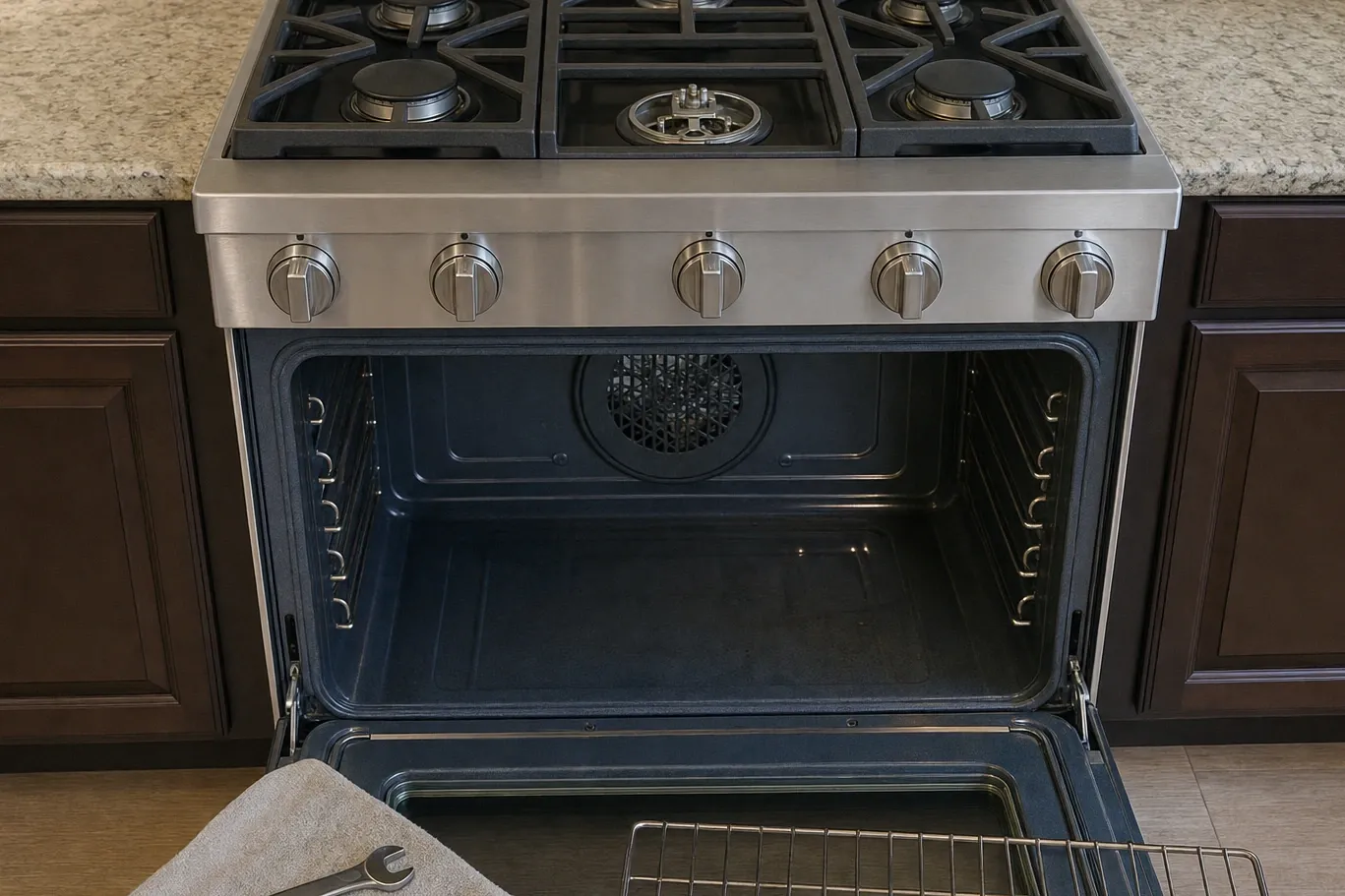
If a burner on your gas stove clicks but never lights and you smell no gas, the likeliest explanation is that gas is not reaching the burner at all: the shutoff valve behind the range is closed, the utility supply has been interrupted, or the burner ports are blocked. The spark is doing its job; it simply has nothing to ignite. Before you start testing, though, treat the missing smell with some suspicion, because a nose that has been hovering over the stove for a while makes a poor gas detector.
The first minute: decide whether this is a safety call
Turn the knob back to off and stop clicking. Then ask honestly whether you caught a rotten-egg or sulfur odor at any point, even a faint one. If you did, or anyone else in the house thinks they did, this is no longer a repair question. NFPA’s advice is to get everyone out right away, put out any open flame, and leave light switches, appliances and phones alone until you are clear of the building. Call 911 or the gas utility (Southwest Gas serves most homes in the Valley) from a phone outside.
The reason for caution even when you smell nothing is what NFPA calls olfactory fatigue: after a minute or two around the odorant added to natural gas and propane, many people simply stop registering it. A fuel gas alarm never gets used to the smell. Under NFPA 715 one belongs close to anything that burns gas and in the hall outside bedrooms, and it is built to go off once gas reaches 10 percent of the lower explosive limit or less, a mixture far too thin to ignite.
Harmless smells versus a real leak
Not every odor near a range means a leak. A brand-new oven gives off a hot, oily smell for its first few uses while manufacturing residue burns away. Food spilled under a grate or baked onto an oven floor smells scorched or smoky. A self-clean cycle can leave a sharp, acrid smell hanging around for hours. None of these smells like sulfur, and none grows stronger with every burner turned off.
A real leak smells like rotten eggs, tends to be strongest low down behind the range, and lingers with all the knobs off. If you cannot tell which one you have, assume it is gas and go outside.
Why it clicks but nothing lights
Once you are confident there is no leak, a quick test tells you where to look. Try each surface burner in turn, and the oven too if it burns gas.
| What happens | Most likely cause |
|---|---|
| Every burner clicks, none lights | Supply: closed shutoff, utility interruption, empty propane tank |
| Oven lights, burners do not | A burner-side fault, not the supply |
| One burner fails, the rest work | Clogged ports, a crooked cap or that burner’s valve |
| Nothing clicks at all | No power reaching the ignition |
If every burner fails, check whether a gas water heater or furnace in the house has also gone out. If so, the trouble is upstream of the kitchen. If they work, look at the shutoff valve behind the range; a range pulled out for cleaning or new flooring sometimes goes back with that valve partly closed. Older homes in Coronado and Sunnyslope may still have stiff original valves, and forcing one is a job for a technician.
The range’s own regulator matters as well. A Viking 5 Series carries its own, preset to deliver 5.0 inches of water-column pressure to the burners when running on natural gas and 10.0 when running on LP, and nobody should ever bypass it. Switching fuels takes the correct kit, LPKPDR01 for LP on the 5 Series, fitted by a qualified installer rather than the owner. A range set up for the wrong gas can spark all day and manage only a weak, unsteady flame or none.
One burner that will not catch
A single stubborn burner is usually a cleaning job. Phoenix tap water is very hard, and when a pot boils over, minerals dry onto the burner head along with the food and close off the small ports the gas has to pass through. Viking’s guidance for the 5 Series is to clear clogged ports with a straight pin, never a toothpick or anything that widens the holes. When you reassemble the burner, keep the head’s tabs clear of the igniter, make sure the cap sits level, and point the arrow toward the back of the range. A cap that rocks or sits off-center is one of the most common reasons a burner sparks without lighting.
Let every part dry fully before testing. A wet igniter after cleaning will often click weakly, or keep clicking, until the moisture is gone.
When it never stops clicking, or never clicks
Constant clicking with a lit flame usually means the flame is not touching the igniter where the range can sense it, often because of a misaligned cap, or that moisture has reached the ignition switch. Keep in mind that the 5 Series relights its surface burners by itself if a flame goes out while gas is still flowing, so a short burst of clicks after a draft or a boil-over is normal behavior rather than a fault.
No clicking at all points to power. Turn the knob off, confirm the cord is plugged in, and check for a tripped breaker or a blown fuse. Viking calls for a grounded three-prong outlet on a separately fused circuit for the 5 Series, so a range sharing its circuit with a microwave or toaster oven can lose its spark whenever that breaker trips.
On a 7 Series with backlit knobs, a red backlight means the range is reporting an error rather than just failing to light, which is worth mentioning when you book.
What the repair visit checks
A proper visit begins by confirming there is no leak, with a detector at the valve, the regulator and each fitting rather than a sniff test. From there it covers gas supply and pressure at the range, the spark at each igniter, the wiring and spark module, the burner valves and the burner heads. On a 5 Series the oven’s bake burner and Gourmet-Glo broiler are lit by the same SureSpark system, so the oven gets checked as well.
Our service call is a flat $89 for the trip and the full diagnosis, and the $89 is subtracted from the repair total when you give the go-ahead. Replacing an igniter or burner assembly typically costs $170–$440, and you get the firm price after diagnosis, before any work starts. We cover Maryvale, Roosevelt Row, Coronado and Sunnyslope; read more about our Viking range repair or call (480) 691-1591. If the range turns out fine and something else in the kitchen is misbehaving, our repair guides are a good next stop.
Follow-up questions
-
What does clicking with no flame tell me about my Viking range?
The spark is working, but fuel is either not arriving at the burner or cannot get out through the ports. Try every burner: if all of them fail, suspect the supply; if only one fails, suspect a clogged head, a crooked cap or that burner's own valve.
-
Why won't my Viking burner stop clicking?
Nonstop clicking usually means the range cannot sense a flame at the igniter, often because a cap sits unevenly, a boil-over left the igniter wet, or moisture reached a switch. A 5 Series also clicks again on purpose when a lit flame blows out, because it relights by itself.
-
Nothing happens when I turn the knob, not even a click. Where do I start?
Check power before anything else. Turn the knob off, confirm the range is plugged in and look for a tripped breaker or blown fuse. A 5 Series is meant to have a grounded outlet on a circuit of its own, and a shared circuit can trip without much warning.
-
Is it safe to keep trying to light the burner with a match?
No, not until you know why the igniter is failing. Repeated attempts can let unburned gas build up, and your nose may stop picking up the odor after a minute or two. Turn the knob off, air out the kitchen and find the cause first.
-
What does a repair cost if the igniter is the problem?
Replacing an igniter or burner assembly typically runs $170–$440, with a firm quote once the diagnosis is done. The visit itself is a flat $89 that covers the full diagnosis and is credited toward the repair if you decide to go ahead.